Friday, 22 May 2015

Washington Irving (1783-1859)

by Robert Bovington

http://astore.amazon.co.uk/spanisimpres-21/detail/1617204625
click on image to buy book
One of the books that all lovers of Spain and its culture should have on their bookshelves is 'Tales of the Alhambra'. The American romantic writer Washington Irving wrote it following an extended stay in Granada.

Whilst in Spain, working for the American Legation, he had spent a brief time in Sevilla before setting out for Granada with a Russian travelling companion in April 1829. On arriving in this beautiful city, he immediately fell under its spell. He had the extraordinary good fortune to spend several months living in the Alhambra. The book is one of the classic travel books. It is a groundbreaking account of his time there including folklore and local gossip about the handsome princes and learned Moors who had lived in the palace during the years of the Moorish Kings' residencies.


http://astore.amazon.co.uk/spanisimpres-21/detail/1495325490
click on image to buy book
Washington Irving had already achieved success as a writer - he had written 'The History of Christopher Columbus' and 'Chronicle of the Conquest of Granada' before his visit to the Alhambra as well as a number of other works that included biographies and essays. However, he is perhaps best known for his short stories. His most famous being 'The Legend of Sleepy Hollow' and 'Rip Van Winkle'.
In 1806, he had qualified as a lawyer but writing was his first love and, following his early successes in this field, he was assured of earning a living as an author - so much so that he was the first American author to achieve International fame. Another title attributed to him was 'first American man of letters'.


more blogs by Robert Bovington...

"Photographs of Spain"
"postcards from Spain"
"you couldn't make it up!"
"a grumpy old man in Spain"
"bits and bobs"
"Spanish Expressions"
"Spanish Art"
"Books About Spain"

As I Walked Out One Midsummer Morning by Laurie Lee

A Review by Robert Bovington

http://astore.amazon.co.uk/spanisimpres-21/detail/0241953286
click on image to purchase book
As I Walked Out One Midsummer Morning (1969) is an autobiographical account of an epic journey around Spain in the nineteen thirties. It is 1934 and Laurie Lee, the author, is a young man. He leaves the security of his Cotswold home to embark on an adventure. 

Initially he travels to London and ekes out an existence by playing the violin and by labouring on a London building site. He decides to go to Spain. It seems a rash decision because the young lad’s choice of destination is based on the fact that he knows a phrase of Spanish - "¿Puede por favor dame un vaso de agua?” – “Will you please give me a glass of water?” 

For a year, he tramps through Spain, from Vigo in the north to Almuñécar on the south coast. 

During this voyage, he experiences a country that ranges from utter desolation to extreme beauty. He manages to eat by earning a few pesetas playing his violin. He sleeps at night in his blanket under an open sky or in a cheap, rough posada though occasionally he is rewarded with the warm and generous hospitality of poor village people that he meets along the way. 

Laurie Lee provides the reader with a vivid account of life in Spain during the bleak years leading up to the Spanish Civil War. 

I enjoy reading travel books, especially those about Spain. “As I Walked Out One Midsummer Morning” is as good as any I have read even though many of the places he visits – Vigo, Valladolid, Cádiz, Tarifa – are described as squalid, dark, decrepit, acrid, and scruffy. Even Seville is both “dazzling and squalid” according to the author. He does praise some of the places he visits - Toro, Segovia, Toledo – who wouldn’t! However, Lee’s descriptions of the places and peoples that he has encountered are couched in an extremely well written and sometimes poetic prose. 

Laurie Lee must have been a good communicator. If we are to believe that he only had one phrase of Spanish then he did extremely well communicating with the people on his travels. His first port of call was Vigo and, I suspect that in July 1935, the ordinary people of that city would have spoken Galician. He would no doubt acquire more words of Spanish as he travelled through Spain but in Córdoba, Seville, Cádiz, Algeciras, Málaga and his final destination, Almuñecar, he would have encountered the Andaluz dialect. A novice in Castilian Spanish might experience some difficulty in understanding the spoken word of the ordinary people of Andalusia. 

I enjoyed this book very much. I would recommend “As I Walked Out One Midsummer Morning” as a thoroughly good read.

Robert Bovington May 2015

Other blogs by Robert Bovington:

"Photographs of Spain"
"Spanish Impressions"
"postcards from Spain"
"you couldn't make it up!"
"a grumpy old man in Spain"
"Spanish Expressions"
"Spanish Art"
"Books About Spain"

Castilian Days by John Hay

I enjoyed this book. Unlike many travel books about Spain, it was not all about cathedrals, churches and castles.

http://astore.amazon.co.uk/spanisimpres-21/detail/1511863390
BUY NOW!
American John Milton Hay was more famous as a statesman than as an author – amongst other things he was the 37th Secretary of State. He had also performed the role of private secretary to Abraham Lincoln and one of his publications “Abraham Lincoln: A History” which he co-wrote with John G. Nicolay was published in 1890.

“Castilian Days” was first published in 1875, though my copy was the Holiday Edition of 1903, recently launched in Kindle e-book format by Project Gutenberg.

The book is a good balance between people and places. The first part of the book is dedicated to the habits and customs of the ordinary people of Castile in the late 19th century. This is followed by a vivid description of the bullfight – a bit too vivid for my liking. Hay describes all the gory details, which includes horses being gored to death – old horses that have been worked to (near) death in the intense heat of summer and the bitter cold of winter. So, if you are squeamish, miss that chapter.


The remainder of the book is less morbid. These final chapters are mostly about some of the “must see” sights of this area of Spain – Madrid’s Prado, Segovia, Toledo, the Escorial and Cervantes hometown of Alcalá de Henares.

The author does include some background history of the places he visits and provides the reader with a balanced account of these locations – sometimes with enthusiasm but with the occasional averse comment.

There is also a chapter about holidays and fiestas.

Unless I am mistaken, there is no mention of the year in which John Hay undertook his journey around Castile. It must have been between 1873 and 1874 because he writes of the country being a republic. Despite the fact that the book is set over a century ago, many of the descriptions applied to the Spanish people and places, in my mind, still hold true today.

Robert Bovington

PS a cheaper version of the book is also available...

http://astore.amazon.co.uk/spanisimpres-21/detail/1419112244
 

Thursday, 21 May 2015

George Orwell

Eric Arthur Blair (alias George Orwell) 
by Robert Bovington 

George Orwell © Robert Bovington
George Orwell fought in the Spanish Civil War and wrote of his experiences in Spain in 'Homage to Catalonia' (1938).
 
He was born Eric Arthur Blair on June 25, 1903 in Bengal, India. However, at the age of one he moved to England with his mother. His father, a Civil Servant, remained in India until 1907. 

Eric Blair was educated at St Cyprian's Eastbourne, Wellington and Eton and had a number of jobs before embarking on a career in journalism. He had a short spell with the Indian Imperial Police in Burma and a brief period as a schoolteacher. 

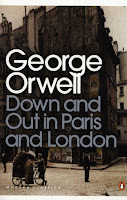
Based on his experiences in Burma, Paris, London and Suffolk he was to write many novels including 'Down and Out in Paris and London' (1933), 'Burmese Days' (1934) and 'A Clergyman's Daughter' (1935). He wrote under the pseudonym of George Orwell. 

http://astore.amazon.co.uk/spanisimpres-21/detail/B00DO8OI12
click on pic to buy
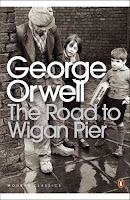
'The Road to Wigan Pier' was published in 1937. It was an account of poverty among the working class in the depressed areas of northern England. His political leanings were distinctly left wing. He had resigned from the Indian Imperial Police because of his revulsion to imperialism and his research for 'The Road to Wigan Pier' reinforced his socialism. 

In 1936, Eric Arthur Blair travelled to Spain, initially to report on the Civil War. He decided, however, to join the growing list of 'foreign' volunteers fighting for the Republicans against Franco's Nationalist Army. Trouble was, he found himself fighting against Communists factions too! He had joined the 'Workers Party of Marxist Unity' - the POUM and fought on the Aragón and Teruel front lines. He achieved the rank of second lieutenant but had the misfortune to be quite badly injured by a bullet through the throat. He recovered but his voice was never quite the same thereafter! 

In May 1937, he fought against the Communists, who were trying to suppress their political opponents, at the Battle of Barcelona. He was nearly arrested due to his membership of the POUM and was forced to flee Spain and return to England. It was these incidents that tempered his left wing views - he was still a passionate Socialist but with a dread of Communism.
.
http://astore.amazon.co.uk/spanisimpres-21/detail/0141183055
'Homage to Catalonia' was published in 1938. The book was an autobiographical account of George Orwell's time in Spain and included not only his personal experiences but also observations about Spain and Spanish life.
.
Back in the UK, Orwell was to continue his journalistic work as well as writing further books including the classics - Animal Farm (1945) and Nineteen Eighty-Four (1949). He died of tuberculosis in January 1950.


Robert Bovington
May 2015


http://astore.amazon.co.uk/spanisimpres-21/detail/B00DO8OI12
click on pic to buy
http://astore.amazon.co.uk/spanisimpres-21/detail/0141183055
click on pic to buy
http://astore.amazon.co.uk/spanisimpres-21/detail/0141184388
click on pic to buy


http://astore.amazon.co.uk/spanisimpres-21/detail/B0092JEJD4
click on pic to buy
http://astore.amazon.co.uk/spanisimpres-21/detail/0141182709
click on pic to buy


<

“Familiar Spanish Travels” by William Dean Howells


A review by Robert Bovington

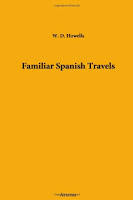
In October 1911, American William Dean Howells travelled to Spain. The author wrote about his experiences in “Familiar Spanish Travels”.

http://astore.amazon.co.uk/spanisimpres-21/detail/1444437593As an avid reader of books about Spain, I have mixed feelings about this book. Certainly, I did not enjoy it as much as other books that I have read on the subject. I found Howells’ literary style too verbose. I wonder whether the author thought: “Why use two or three pithy adjectives when two or three pages of text will do the same job!”

He describes with great detail the strangers that he encounters on his travels, yet often provides little detail on the principal sights. Many of Howells’ sentences are inordinately long – 40, 50 words or more! Yet, despite his longwinded descriptions, Howells manages to convey his thoughts to the reader in both a poetic and an extremely descriptive manner. The reader can easily imagine the bleakness of the Meseta and the “insurpassably dirty and dangerous” gipsy quarters of Granada and Seville. 

Howells certainly was not, what we today call, politically correct. He frequently describes some of the Spanish women as fat. Nor did the author view his surroundings with rose tinted spectacles. He mentions bad breakfasts; freezing hotels, cold rainy streets and “the thick and noisome stench” of Cervantes former home in Valladolid. But he waxed lyrical about a great deal of his experiences too: the incomparable grandeur of Burgos Cathedral; the glorious masterpiece that is Murillo’s “Vision of St Anthony”; the unparalleled beauty of the Alhambra and the magnificent structure that is the Puente Nuevo in Ronda are shortened versions of just some of his descriptions.

I know people’s tastes are different but what really surprised me was the author’s likes and dislikes regarding the places he visited. He did not like Córdoba but, to be fair, it was raining during his visit and he described the houses as “wet and chill”. However, he was also disappointed in that city’s beautiful Mezquita. Yet he really liked Algeciras! 

Certainly, from the author’s text, I gathered that he preferred ‘people watching’ to visiting the famous sights, which probably explains the imbalance between his descriptions of people and his accounts of the places visited. But, then, the whole expedition was unbalanced. He spent only half an hour in Toledo’s magnificent Cathedral and not much longer in the Mezquita, yet he visited Seville Cathedral every day during his fortnight’s stay! He appears to have enjoyed Madrid, especially the Prado and he was greatly taken with Granada though, more for the views from within and without the Alhambra than for the wonderful Arabic architecture. He preferred the Palace of Charles V to the Nasrid Palaces in that magnificent monument to the Moors rule in Spain.


Notwithstanding the author’s idiosyncrasies, “Familiar Spanish Travels” will probably be an enjoyable read for those readers who wish to partake of a “warts and all” commentary of life in early 20th century Spain.

Robert Bovington
21 May 2015

http://astore.amazon.co.uk/spanisimpres-21/detail/B004BO4NA4
1913 hard cover
http://astore.amazon.co.uk/spanisimpres-21/detail/B00AAPLMGQ
1923 reproduction
http://astore.amazon.co.uk/spanisimpres-21/detail/B000FC1YIA
Kindle


"Photographs of Spain"
"Spanish Impressions"
"postcards from Spain"
"you couldn't make it up!"
"a grumpy old man in Spain"
"Spanish Expressions"
"Spanish Art"
"Books About Spain"

Tuesday, 19 May 2015

Anti-Social Media

http://astore.amazon.co.uk/spanisimpres-21/detail/B00UHZXISO


By Kate Beth Heywood

 Product Description

Constance Anderson is a scriptwriter... without a script. This wasn't a problem until by random stroke of fate the mega-famous Hollywood diva Jennifer Roberts announces on American primetime television that Constance is writing her next movie.

But this is news to Constance; how the hell did that happen? She is jettisoned to fame overnight and faces a race against time to write the script. With the help of an unscrupulous 'agent' and a hostile ghost writer, Constance battles her way to Hollywood through the onslaught of social media, trolls, a philandering boyfriend, and leaked naked photographs...

Social media paves the way for an unknown scriptwriter in a comedy of misunderstandings and miscreants, and finally an ounce of good luck.

http://astore.amazon.co.uk/spanisimpres-21/detail/B00UHZXISO


The Girl Who Played with Fire by Stieg Larsson

"The Girl Who Played With Fire" - review

http://astore.amazon.co.uk/spanisimpres-21/detail/1906694184
There ought be a health warning with this book - I found it so enjoyable, I couldn't put it down and I therefore sat reading all day instead of going for a walk. 

I really enjoyed "The Girl with the Dragon Tattoo" and couldn't wait to start reading the sequel. In my opinion, this second book of the "Millennium Trilogy" is even better. 

 http://astore.amazon.co.uk/spanisimpres-21/detail/1906694184
 
We get to know more of the enigmatic Lisbeth Salander who is wanted by the police in connection with some brutal murders. Of course, our heroine (if we can call someone that has been labelled a raving, sociopathic, murdering, satanist, lesbian a heroine) is eventually found to be innocent of the crimes. More than that, we get to understand more of why Lisbeth is the way she is. 

There are other interesting characters, both good and evil including the other main character from the first book, journalist Mikael Blomkvist. 

This book is full of excitement and twists and turns and I can't wait to read the third book in the trilogy. What a shame that the author Stieg Larsson died before writing further books. I'd love to read more about Lisbeth Salander!

http://astore.amazon.co.uk/spanisimpres-21/detail/B003INM8YCI hope you enjoyed this review.

You may prefer to buy the complete trilogy...


http://astore.amazon.co.uk/spanisimpres-21/detail/B003XQFAC6 

 p.s. I would also recommend the DVD....


 View all my reviews 

other blogs by Robert Bovington:
 
"Photographs of Spain"
"Spanish Impressions"
"postcards from Spain"
"you couldn't make it up!"
"a grumpy old man in Spain"
"Spanish Expressions"
"Spanish Art"
"Books About Spain"